The Nankivell News
by Doug Mumma
Updated 12 July 2018
|
The Nankivell Newsby Doug MummaUpdated 12 July 2018 |
|
This page is devoted to my wife's English Nankivell ancestors. Joan's grandmother's name was Jane (Jennie) Elizabeth Nankivell and she was born in the Isle of Dogs area of London. Due to the tough economic times that prevailed in England at the turn of the century, Jennie and her children, along with two other sisters, migrated from England to Canada in 1914 and then to San Diego, California in 1915. After a few years, they were joined by another sister and a brother, all settling in the San Francisco Bay Area where many of their descendants live today. The family has remained very close.
The origins the Nankivell surname in England is found in the St. Columb Major area of Cornwall. Unfortunately, we have not been able to connect Joan's Nankivell ancestors with any of the known Nankivell families of Cornwall. Joan's earliest Nankivell begins with William Nankivell who was born about 1789 in Poplar area of London. This docklands area of the Thames River in London is called the "East End" where they could "hear Bow Bells". Anyone living near enough to hear the bells of Bow Church was generally thought to be Cockney, but the Nankivells were not. William married Ann North on 25 Mar 1810 in the very fashionable church of St George Hanover Square, Westminster, England. Witnesses to their wedding were a John and Jane Nankivell. Of note, a John Nankivell and Jane Westlake were married in the same church on 19 May 1805, five years earlier. Perhaps these witnesses were William's brother and wife, but their relationship is unknown at this time.

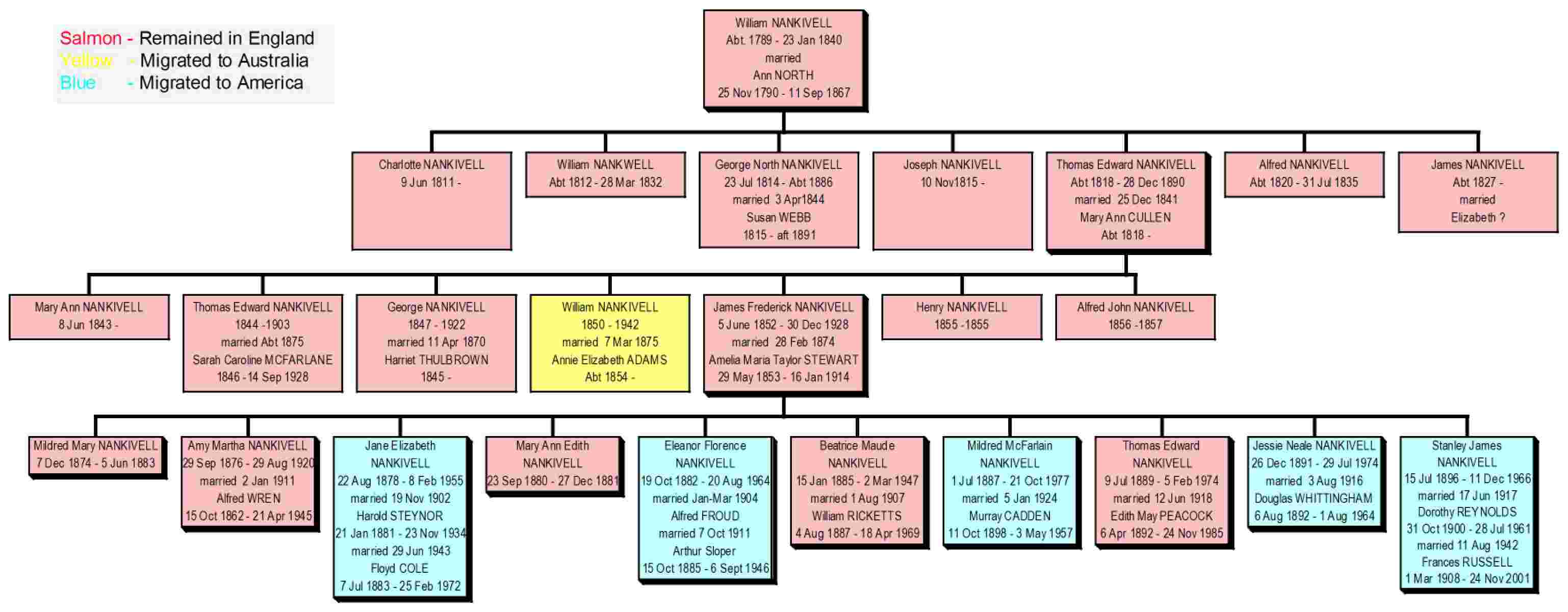
This branch of the Nankivell family lived in the Poplar/Isle of Dogs area of London for over 125 years before some descendants migrated to America and Australia. The families made their livings by serving the shipping industry in one capacity or another. William Nankivell and his descendants are shown in the chart below.
Much of the early research into the origins and genealogy of the various Nankivell branches was done by a person named Edith Nankivell, who lived in America. The family was originally from England, but moved to Australia. Edith's grandfather later moved to Japan and eventually to New York City around 1896. Edith became intersted in her ancestors and began a quest to contact and identify all Nankivells worldwide. In the process, she developed a "Notebook" in which to organize and store the information from various "Nankivells" that she contacted, including one of my wife's cousins. Edith also collaborated extensively with a lady by the name of Anne Williams of Australia. Using all of the information she gathered, Edith created numerous descendant charts to help display the data visually. Unfortunately, Edith died in 1991 long before her quest and Nankivell research was completed.
I wished to see Edit's charts and "Notebook" so I went on a quest in 1997 to find Edith's sister, Julia Nankivell Hollister. I figured that she likely ended up with her sister's genealogy research. Fortunately I was able to make contact with Julia and she graciously copied the primary pages from Edith's Nankivell "Notebook" and sent them to me. I scanned the document and saved it as a PDF file. If you would like to view pages from Edith's "Notebook", you may view/download it from my website. The file, containing all of the pages Julia sent me, is rather large. I also created an abbreviated version containing just the Key Charts along with some general information pages. Click on either link to view/download the files - they are big.
http://www.mumma.org/nankivell/EdithNankivellCharts+.pdf Just the charts and general information ----- 7.3 Mb (16) pages
http://www.mumma.org/nankivell/EdithNankivellNotebook.pdf All pages from Edith's Notebook ------- 79.8 Mb (102 pages)
In Edith's numbering system, Joan's branch of the Nankivell family was identified as "Family 307" and they are shown on Chart 4 on the right hand side under the name of James Frederick Nankivell.
A Nankivell researcher who has gathered extensive information about the Nankivell families is Anne Williams of Victor Harbor, South Australia. She has been researching Nankivell family history for over 30 years. She and Edith Nankivell collaborated on much of their Nankivell Research. An excerpt from a book written and published by Anne in 1986 is shown below. Anne Williams may be contacted by e-mail at oznank1@gmail.com
Another researcher who has collaborated with Anne Williams on Nankivell research is Hugh NanKivell who lives in Perth, Australia. Hugh has assembeled a large database of Nankivell descendants which he uses to help identify and interconnect various Nankivell branches for the Nankivell Surname DNA Project. Hugh can be contacted at hughnankivell@iinet.net.au
History of the Nankivell Family
(Excerpts from Anne Williams' 1986 Book, "Nankivell, A Family Affair")
Exact origins of the family seem lost in the mix of early peoples of Cornwall. Some believe that the family extends back to the early Celts who inhabited Cornwall. Some people believe that people from the Iberian Peninsula came to England about the time of Christ, looking for tin, which at that time could be picked up from the surface of the earth. Others of the family believe that the family came from France with William the Conqueror in 1066 or were survivors of the Spanish Armada of 1588.
The origin of the name Nankivell is variously derived fromNan/Nant/Nance, which is Cornish for a valley, plus a personal name Cyfel, or a form of Welsh Ceffyl, meaning "horses". The actual place from which the family took their name is no doubt Nanskeval in the Parish of St Mawgan in Pyclar, which was spelt Nanscuvel in 1277. All that remains of Nanskeval is a glen of fine old oak trees about two miles from St Columb Major.
The Dictionary of British Surnames gives the following reference to the name:
Nankivell - from Nans-Cyfel: Valley of Cyfel (personal name), or possibly NansCeffyl (Welsh) Valley of Horse found midwest and northern Cornwall.
There is also a theory that the name is pure Celtic and means the "Glen of Woodcocks". Whichever, the name means a type of glen or valley.
The earliest known record of a clan member is dated 1324, at which time the lands of St Columb Major were conveyed and granted to Odoni de Nanscuvel and Rose his wife. The estate is very old; and none of the original buildings remain. Other early surviving records include: Nanscuvel of 1277; John Nanscuvel of 1327 and 1362; Richard Nanscuvel of 1394 and Odo cle Nankevill, a cleric who lived in 1375.
About 1400 a King's Herald, by the name of Typpett, came into possession of Nankivell property and then took the family name. The Typpett family became known as Typpett alias Nankivell, then TyppettNankivell, then Nankivell. This Nankivell family is still associated with the area of St Columb Major.
The family of St Columb Major, Cornwall, reaches back furthest into antiquity with its documentation beginning about A.D. 1450 with Typpett, the King's Herald, coming into possession of the Nankivell lands. Earliest records show mostly the line of inheriting sons. It is thus difficult to establish connections with this family, but tradition has it that there are many connections.
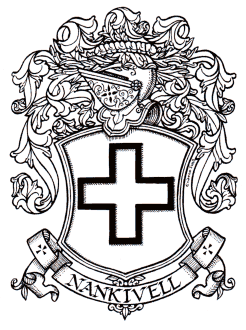
A proclamation was made by Henry V that any Coat of Arms not in existence at the Battle of Agincourt in 1415 were forbidden and that Coats of Arms could only be inherited or granted by the King. Therefore one can assume that the Nankivell Coats of Arms were in existence before 1415.
Between 1530 and 1686 heralds recorded all coats of arms in existence and the genealogies of those bearing them and it is from the Heralds Visitations of 1620 when it appears that several generations before that year there was a certain Typpett Nankevell of St Columb Major. From him descended various Nankivells until John in 1620 described himself as John Nankivell "alias Tippett".
The Coat of Arms recorded at the Visitation was "Argent, on a Cross Hummettee Sable, Voided". In other words, a silver shield with a short armed black cross, the centre of the cross being cut away to leave just the black outline. Variations of this and also different Arms for Tippett were used at various times, with or without crests, i.e. helmet decoration.
In most cases arms were not granted for any special reason of merit, worthy deeds, etc. In general they were simply assumed or officially registered as the distinctive device of a more or less prominent family.
The ancient Coat of Arms of the Nance family of Cornwall are similar, thus, it is possible that the Nankivells, also known as Nancekivell, may have adopted their Arms owing to a similarity in the two names.
A broad history of the family from the 1600s seems to be that the Nankivells were miners (tinners) of Cornwall.
The Nankivells, who in the late 17th century, settled at St Agnes, are thought to descend from the St Columb family. By about 1690, the third generation of the St Agnes family included four brothers: Richard, Benjamin, Samuel and Samson. Each of the brothers left many descendants.
Revised Nankivell History Information
(Contributions from Edmund Typpett Nankivell in 2018)
From Edmund Nankivell's personal research about the origins of the Nankivell family and his particular branch, he discovered a few inconsistencies and errors in the information recorded in Anne William's 1986 book and he wanted to share his discoveries.
The idea that the Nankivell name means "Valley of the Horse" as the Cornish-Celtic for horse is quite different from Welsh Celtic (horse is margh in Cornish). Therefore, the meaning must be "Glen of the Woodcocks". The woods nearby are noted for having woodcocks living there, an otherwise very rare bird in Cornwall. Also, the book, "The Registers of St Columb Major, Cornwall - 1539 to 1780" published in 1881 says exactly that:- "The name Nankivell is pure Keltic, and means "Glen of the Woodcocks"; a glen so-called (generally spelt Nanskevall), with its old oak wood, lies about two miles from St. Columb". This book is available for viewing/download online at https://archive.org/details/registersofparis00stco
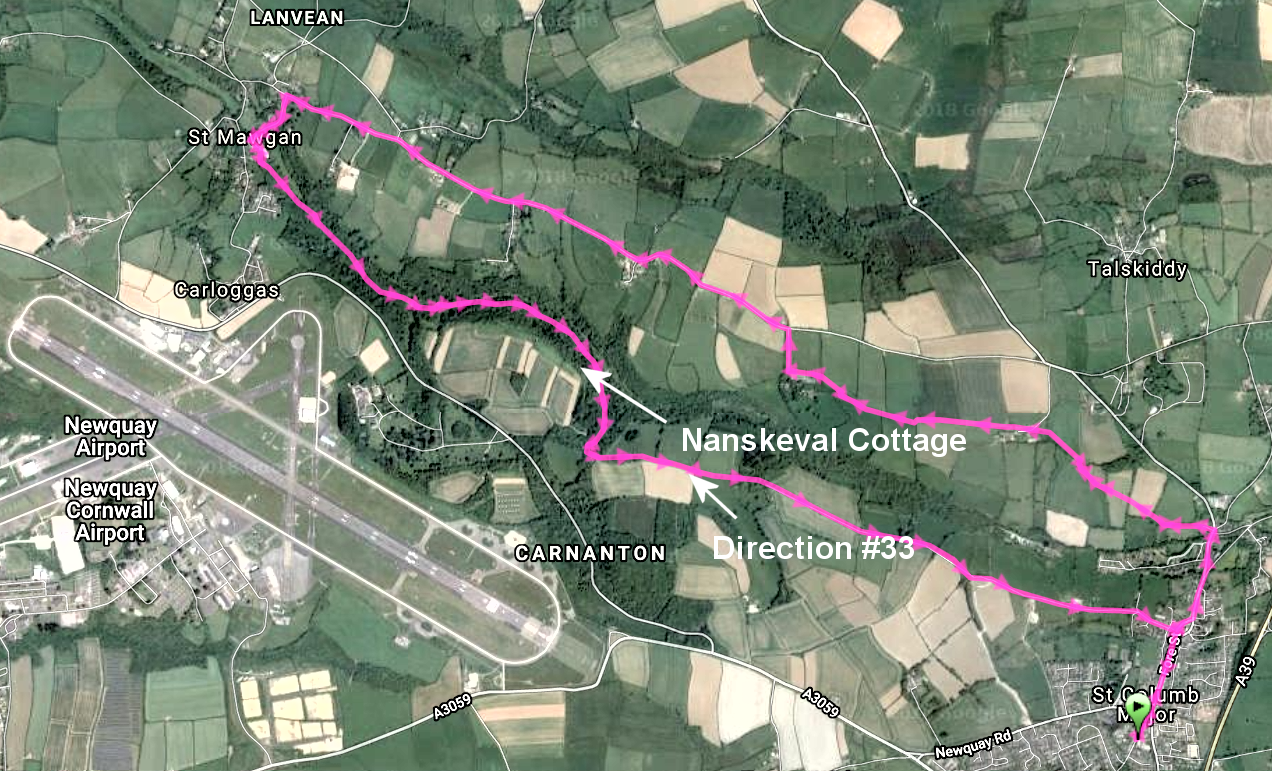
This intrepretation is consistent with that found in the Wikipedia discussion of the Nankivell surname which can be found at https://en.wikipedia.org/wiki/Nankivell. This website also shows a nice picture of the old Nanskeval House which was torn down in the mid 1970s. While the main house was torn down, the Nanskeval Cottage still remains and it was located not far from the House. The Nanskeval Cottage resides on the private lands of Carnaton House Estate, however, there is a foot path which passes near the rear of the cottage and property. The walk and path are described in a walk from St. Columb Major to St. Mawgan. The Nanskeval farm is even mentioned in Direction #33 of the walk which states:
Cross the stile and bear left onto the track. Follow it until it ends at a gate and stile before a lane. In 1819, an ingot of tin weighing nearly 18kg was found at Nanskeval Farm, buried nearly a metre below the surface in swampy ground. It was cast in Roman times, probably using an open granite mould, and is stamped with the head of a soldier wearing a Roman helmet. It is now in the Truro Museum.
The map below visually shows the path of the walk and the relative location of the Nanskeval Cottage and Direction #33.
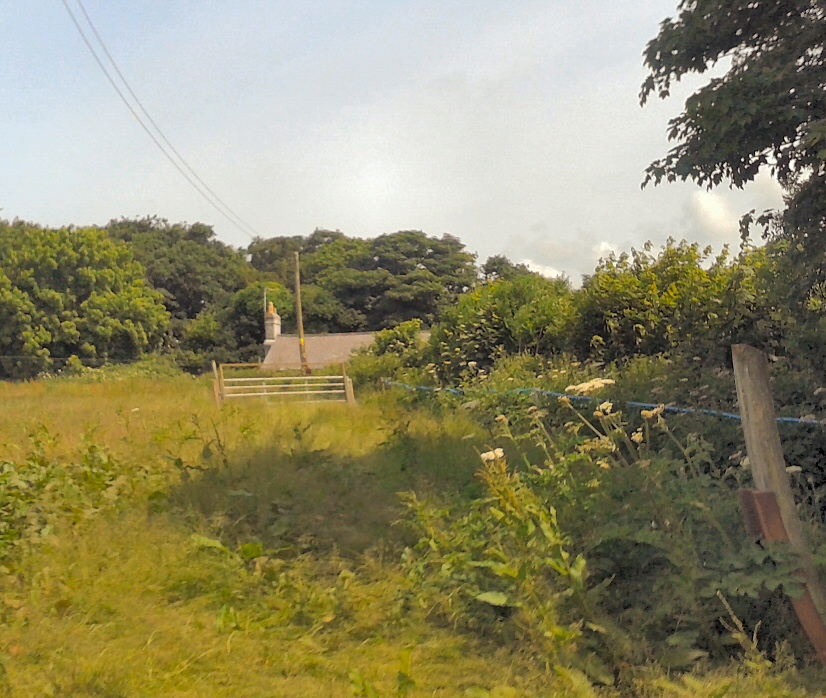
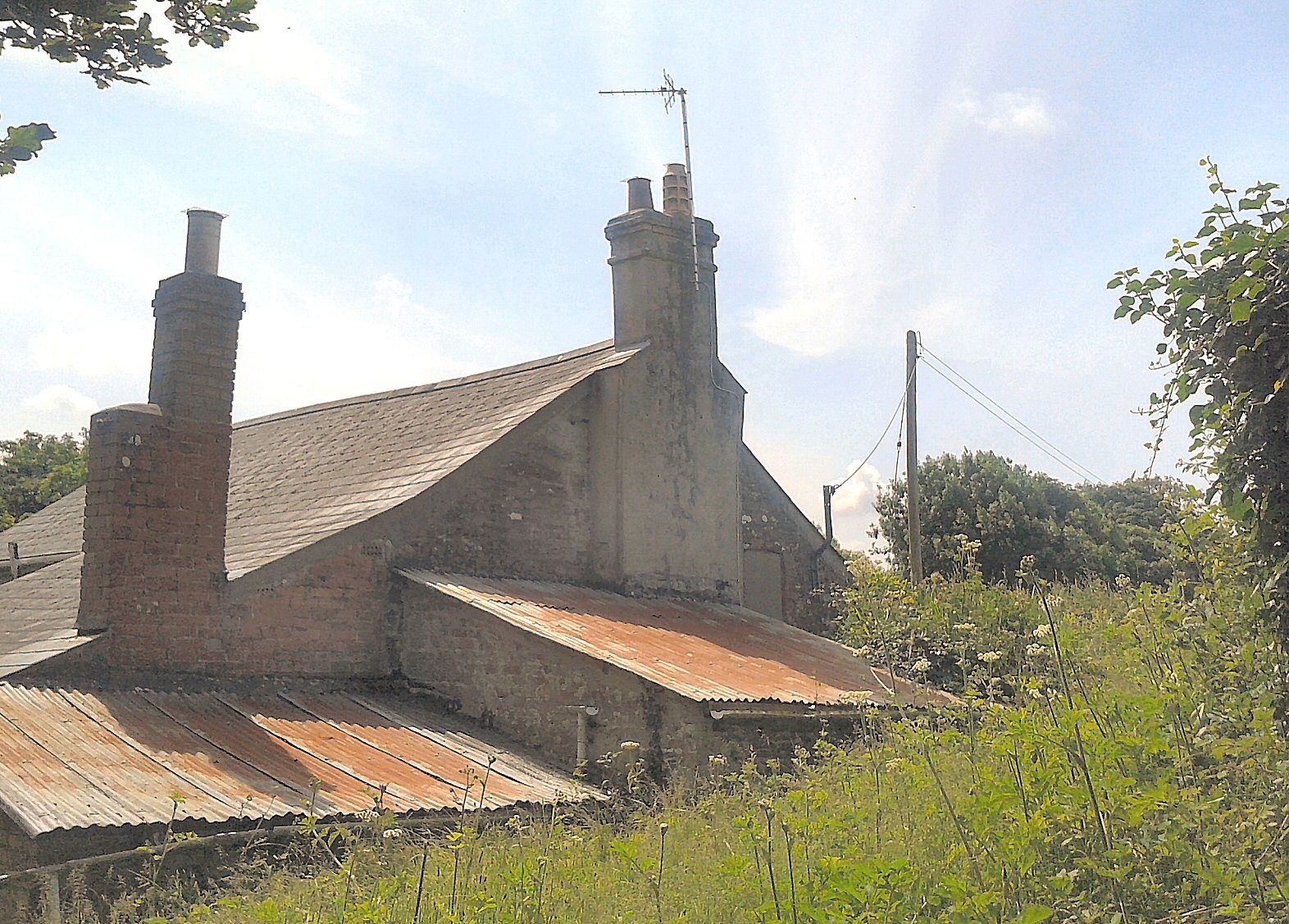
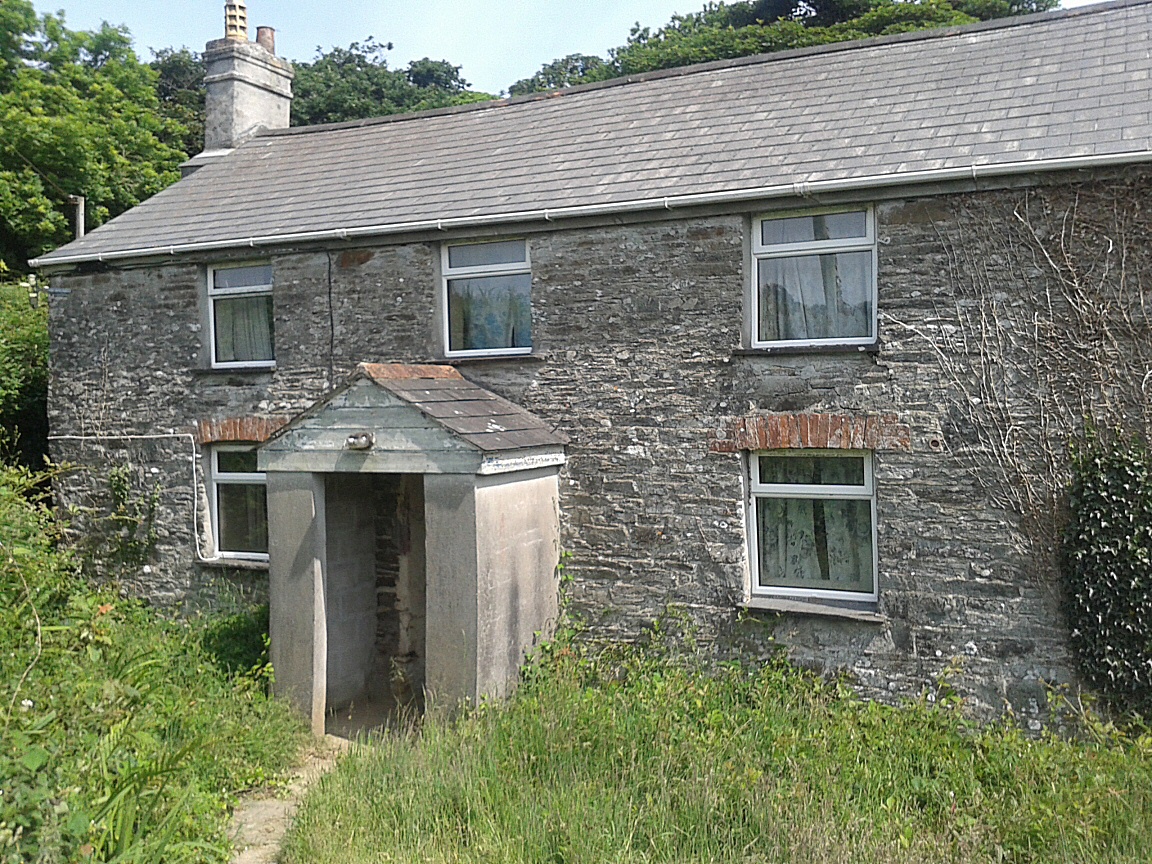
In June of 2018, Edmund visited the Nanskeval Cottage and took several pictures. He made the following comments:
The Nanskeval Cottage is just about 2 miles to the west of St Columb Major where my research has shown that Nanscuval - Glen of the Woodcocks, was/is. This is where our Nankivell name originated from of course, back in the 14th century (Odo de Nanscuval and his wife Rosée).
It appears as if some unfinished work was done to make it inhabitable:- TV aerial, some but not all new windows, plus mains electricity supplied. Good roof with good gutter at the front - pretty rough along one side!
There is no road and in fact even no pathway to it. It looks as if work stopped, unfinished, quite a while ago and it is clear no-one lives there.
Nankivell Surname DNA Project
It is generally expected that all families with the Nankivell surname (and similar name spellings) descend from a common ancestor in Corwall, England, but documentation is lacking in many cases. There are a large number of Nankivell branches that can not be connected with other families. Such is the case with my wife's Nankivell ancestors. Her earliest documented Nankivell is a William Nankivell who was born about 1789 in Poplar district of London. He and his descendants were associated with the sea in one capacity or another. Family legends and traditions suggest that the family came from Cornwall, but no documented proof has ever been found.
Y-Chromosome DNA research has demonstrated that men who exhibit the same DNA "fingerprint", called a haplotype, share a common ancestor in the recent past and are genetically related. I have demonstrated this myself with the Mumma Surname DNA Project which was the first privately funded surname project started in the year 2000. From the results of this project, an adopted man was determined to be a Mumma descendant and eventually the connection was discovered. Likewise, several men who use the MUMMA surname were determined to not be Mumma descendants, but actually Mummey descendants whose genetic ancestry is quite different.
Because of the successes of the Mumma Surname Project, I created a "Nankivell" Surname Project at Family Tree DNA, the oldest and most distinguished company doing Y-chromosome DNA testing. The initial objective of the project was to compare the results of my wife's Nankivell cousin with someone who had documented genealogical evidence back to the earliest Nankivells. Fortunately, I had already made acquaintence with Edmund Typpett Nankivell whose father had their genealogy professionally traced back to John Typpett-Nanskevall. Edmund agreed to test and the results of 37 STR markers showed an extremely close DNA match, confirming that my wife's London twig of the Nankivell family tree indeed connected with the earliest Nankivell's of Conrwall. Unfortunately, we can only trace back to William Nankivell, born about 1789 in the Poplar (Isle of Dogs) area of Longdon. Since the initial test, 10 other men have tested, confiming that all of them share a common Nankivell ancestor in the distant past.
A table showing the STR results as of June, 2018, with most men having tested to 111 markers, can be viewed at:
https://www.familytreedna.com/public/nankivell?iframe=ycolorized
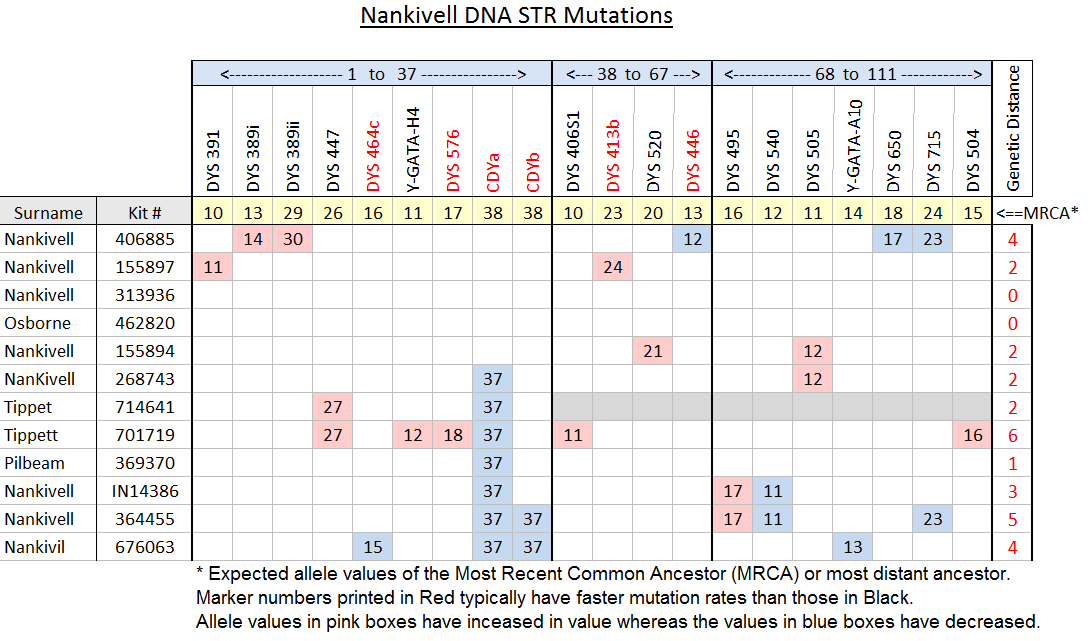
The table shows the allele values that were recorded for each man at specific locations on their Y-Chromosome. These allele values "mutate" or chnage very slowly over time for the DNA from a particular surname. Typically, one expects to only see a few mutations from men over many generations who share a distant common ancestor. Mutations, or changes from the average value have been colored to make it easier to view where and how many mutations occur. Several different surnames also appear due to illegitimate births.
To simplify the viewing of the 111 marker results, the results from the online table were condenced to only display those alleles (markers) whose values show a difference. As you can see very few mutations (allele changes) appear.
An alternate way to display these results is with a mutation tree chart which displays how each participant might be related and connected, based on a minimal number of mutation paths. The box labeled as MRCA would represent the oldet "common ancestor" Nankivell, Then down from him, the various descendants appear along with their respective mutations which have occurred.
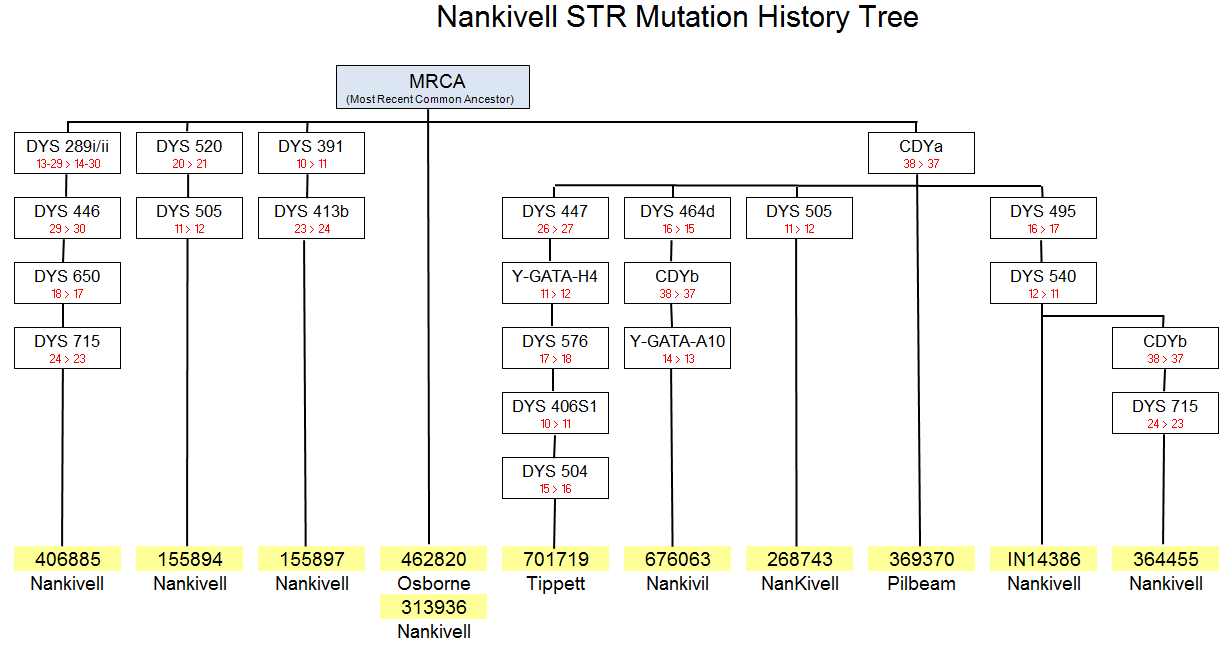
Additional, newer SNP testing is being conducted to better understand the early origins of the Nankivell family and those result should be reported on the Nankivell Surname DNA web page at:
https://www.familytreedna.com/groups/nankivell/about/
Summary - From these results, a Nankivell Surname "ancestral haplotype" has been determined which can be used as a reference for comparison with other Y-chromosome results. These results can be used to determine whether men descend from a common Nankivell ancestor.
Joan's Nankivell & Steynor Ancestors
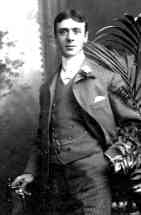
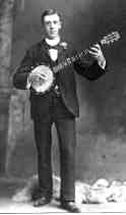
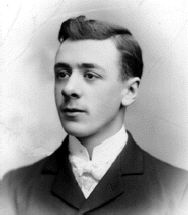
Three pictures of Joan's grandfather, Harold Steynor, taken between 1900 and 1910. He played the banjo professionally before his marriage to Jane Nankivell.
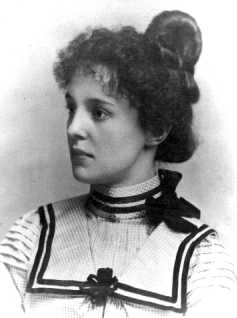
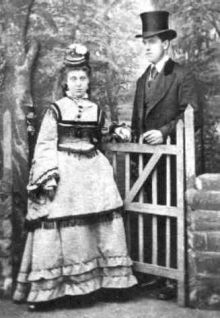
Shown above is a picture of Joan's grandmother, Jane (Jennie) Elizabeth Nankivell Steynor (taken abt. 1900). Next is a photograph of Joan's great grandfather, James Frederick Nankivell, and her great grandmother, Amelia Maria Taylor Stewart, taken on their wedding day, 28 February 1874.
American Nankivell/Steynor Family Gatherings
Joan's family of aunts and uncles has always had very close bonds, starting with their origins in London. The families were poor and needed to rely on each other for support to live and survive. These close connections remained strong during their migration from England to Canada in 1914, to San Diego, California in 1915 and eventually to the San Francisco Bay area around 1916. A story describing the migration of this branch of the Nankivell family to America can be viewed/downoaded by clicking on this link Nankivell Migration to America. The families always got together each year to celebrate the joy of their families and this tradition continues to this day with an annual family Christmas party of the Nankivell-Steynor families. Pictures of these gatherings are shown below. I consider their first Christmas together in Canada in 1914 as the first party. Unfortunately, not many pictures survive from those early gatherings.
In 1991, a new tradition was started with an annual gathering of all of Joan's first cousins at some cabins owned by several of the cousins near the town of Quincy, not far from Lake Tahoe in the High Sierra Mountains of California. The ages of all her cousins are within a few years and they grew up living very near each other, almost like brothers and sisters. This annual retreat to the mountains allows them to continue their close relationships and reminisce about their fond childhood memories. The families were never rich monetarily, but have always been blessed with an abundance of love and friendship. This group of cabins have been nicknamed the Quincy Quality Compound.
[Click on an image to view a higher resolution picture or individual pictures, if available]
| Annual Nankivell - Steynor Christmas Parties | |||
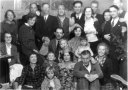 |
December 1935 - The 21th annual Nankivell/Steynor Christmas Party was held at the Hudson Street house in Oakland. There were 23+ attendees. | ||
| Annual QQC Gatherings of the Senior Steynors | 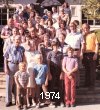 |
December 1974 - The 60th annual Nankivell/Steynor Christmas Party was held at the Montclair Clubhouse in Oakland. There were 41+ attendees. | |
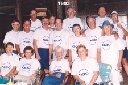 |
July 30 - August 2, 1993 - The 1st meeting of the senior Steynor Clan members at the QQC (Quincy Quality Compound) near Quincy, CA. | 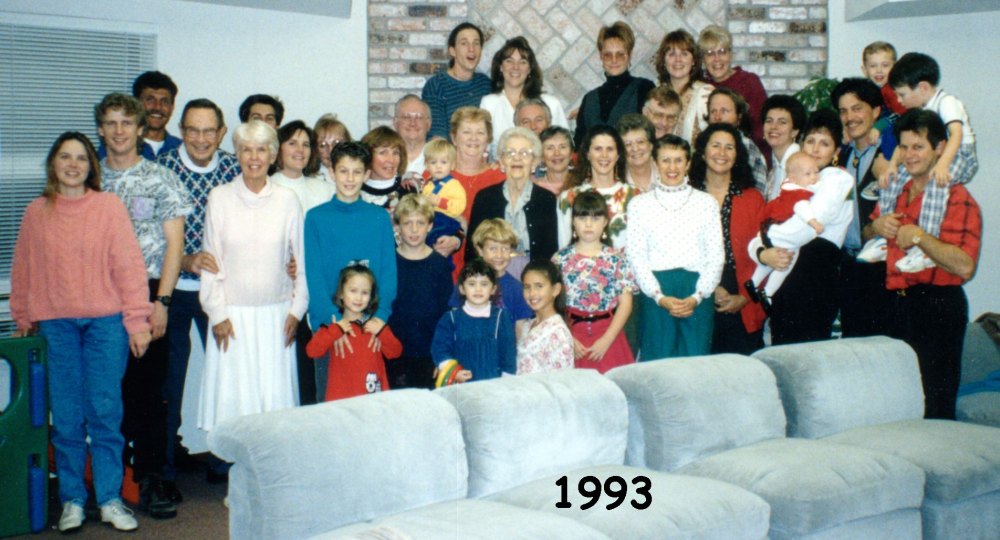 |
December 4, 1993 - The 79th annual Nankivell/Steynor Christmas Party at the Brookmeadow Clubhouse in Livermore. There were 42 attendees. |
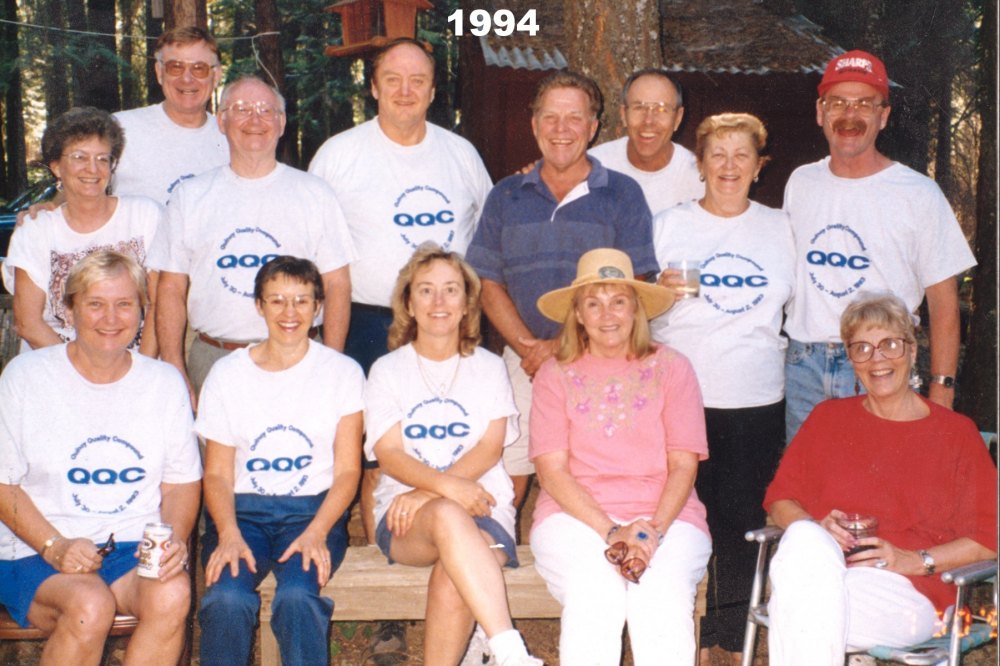 |
July 29 - July 31, 1994 - The 2nd annual meeting of the QQC. |  |
December 6, 1994 - The 80th annual Nankivell/Steynor Christmas Party. |
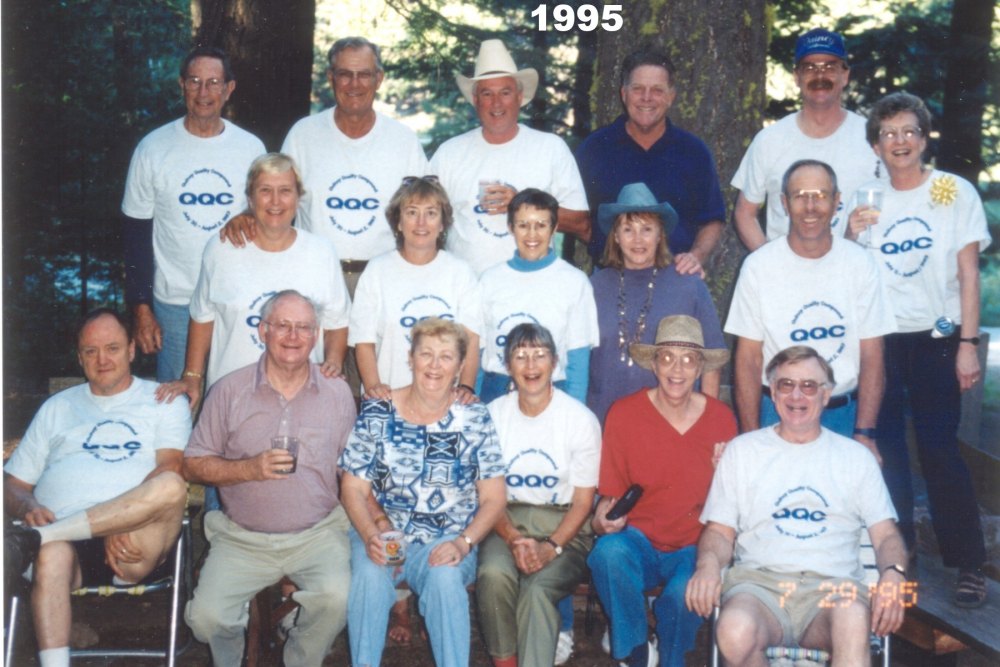 |
July 28 - July 30, 1995 - The 3rd annual meeting of the QQC. | 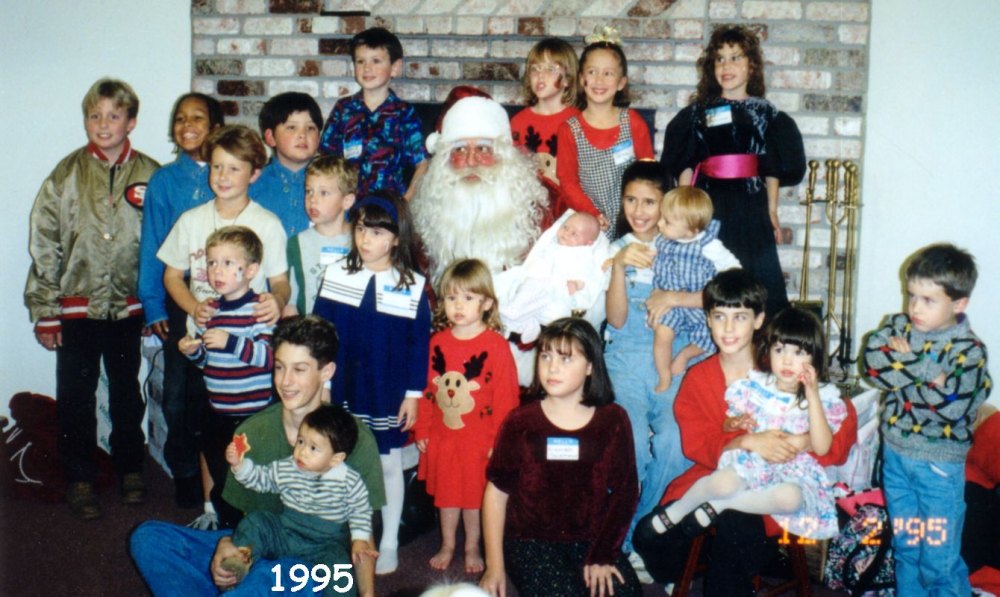 |
December 2, 1995 - The 81st annual Nankivell/Steynor Christmas Party. |
 |
July 19 - July 21, 1996 - The 4th annual meeting of the QQC. |  |
December 7, 1996 - The 82nd annual Nankivell/Steynor Christmas Party. There were 61 attendees. |
 |
July 18 - July 20, 1997 - The 5th annual meeting of the QQC. | 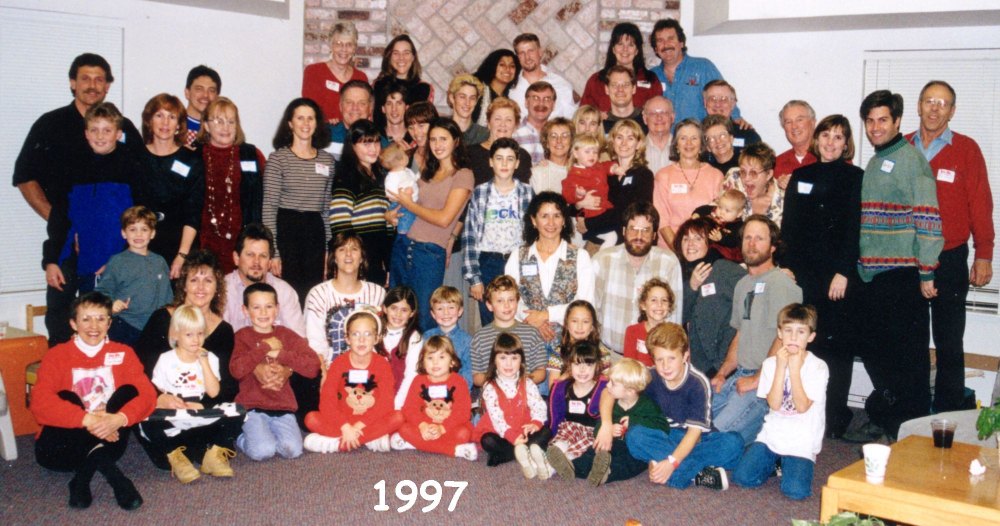 |
December 6, 1997 - The 83rd annual Nankivell/Steynor Christmas Party. There were 60 attendees. |
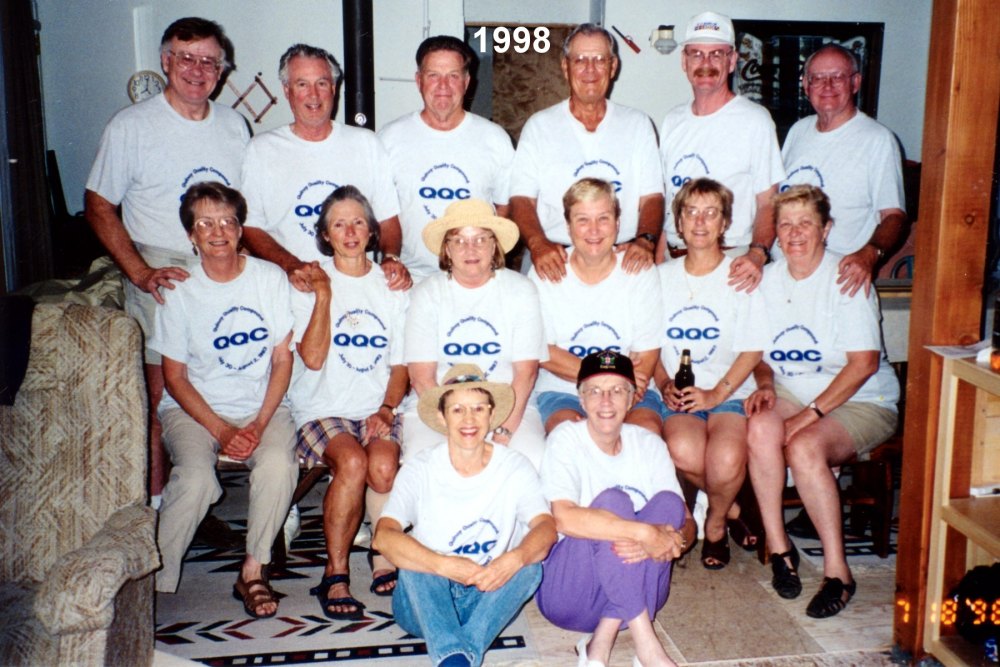 |
July 16 - 19, 1998 - The 6th annual meeting of the QQC. | 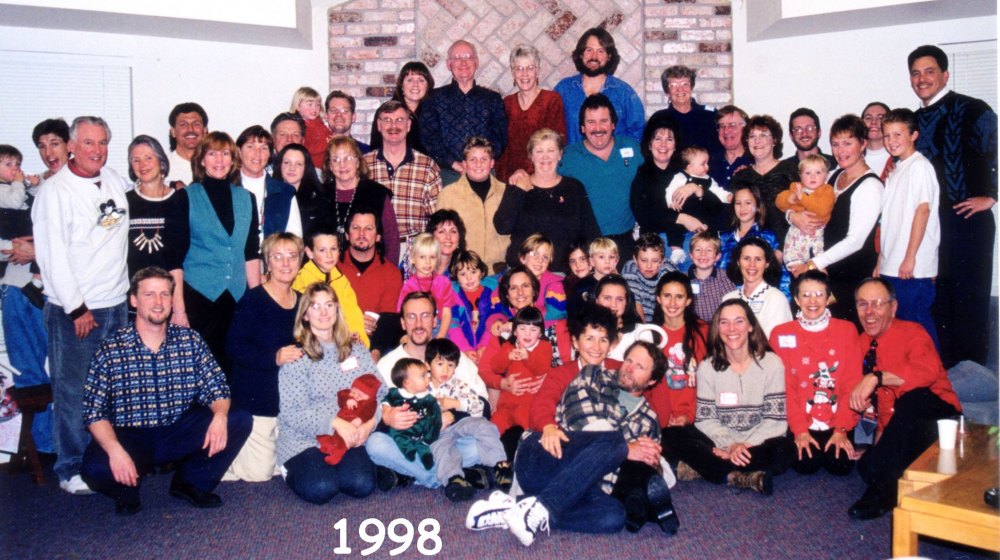 |
December 6, 1998 - The 84th annual Nankivell/Steynor Christmas Party. There were 60 attendees. |
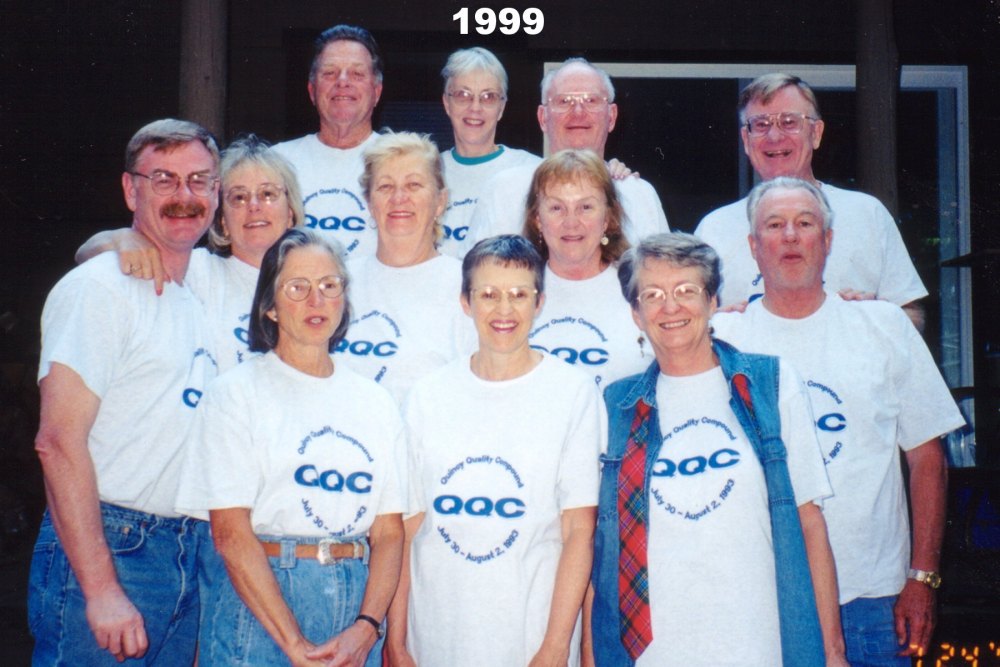 |
July 22 - 25, 1999 - The 7th annual meeting of the QQC. | 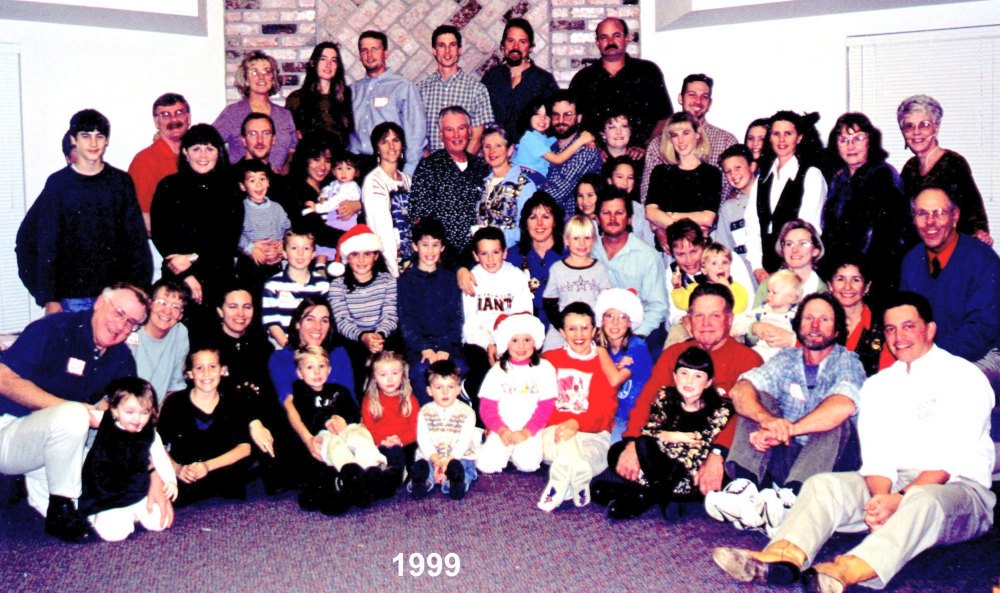 |
December 4, 1999 - The 85th annual Nankivell/Steynor Christmas Party. There were 62 attendees. |
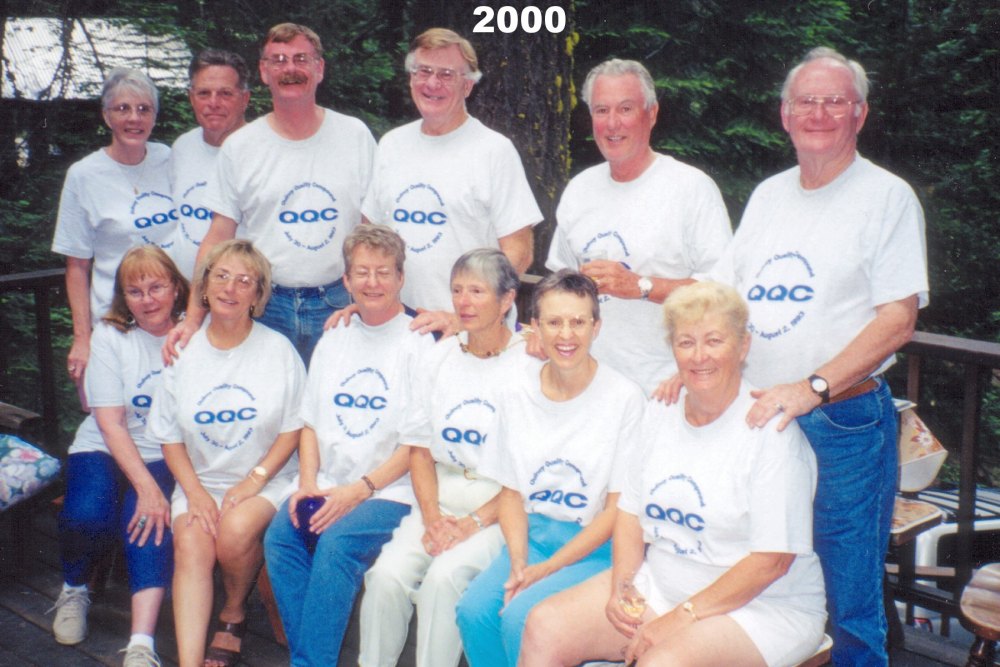 |
July 13 - July 16, 2000 - The 8th annual meeting of the QQC. | 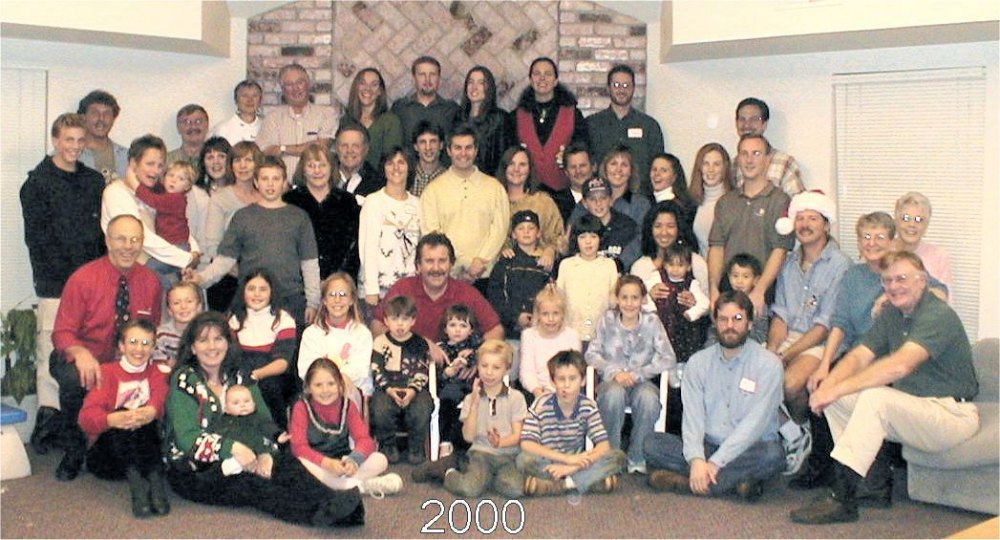 |
December 2, 2000 - The 86th annual Nankivell/Steynor Christmas Party. There were 59 attendees. |
 |
August 2 - August 5, 2001 - The 9th annual meeting of the QQC. |  |
December 2, 2001 - The 87th annual Nankivell/Steynor Christmas Party. There were 62 attendees. |
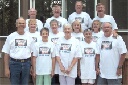 |
July 25 - July 28, 2002 - The 10th annual meeting of the QQC. | 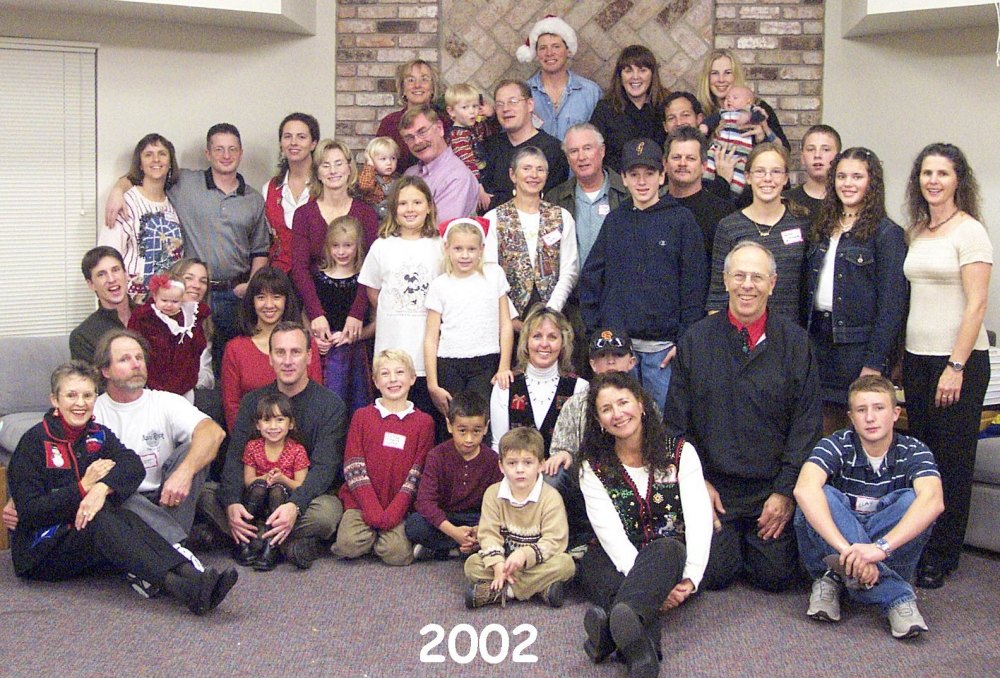 |
December 7, 2002 - The 88th annual Nankivell/Steynor Christmas Party. There were 46 attendees. |
 |
July 31 - August 3, 2003 - The 11th annual meeting of the QQC. |  |
December 6, 2003 - The 89th annual Nankivell/Steynor Christmas Party. There were 49 attendees. Click HERE to view/download an index key for the people in the photo. |
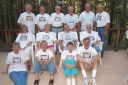 |
July 28 - July 31, 2004 - The 12th annual meeting of the QQC. |  |
December 4, 2004 - The 90th annual Nankivell/Steynor Christmas Party. There were 57 attendees. |
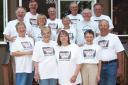 |
July 25 - July 28, 2005 - The 13th annual meeting of the QQC. Additional photos of the frivolity can be seen by CLICKING HERE. |  |
December 3, 2005 - The 91st annual Nankivell/Steynor Christmas Party. There were 55 attendees. Party photos with Santa Claus are available by CLICKING HERE. |
 |
July 13 - July 16, 2006 - The 14th annual meeting of the QQC. |  |
December 2, 2006 - The 92nd annual Nankivell/Steynor Christmas Party. There were 28 attendees. |
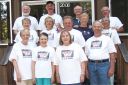
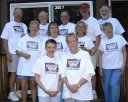 |
July 12 - July 15, 2007 - The 15th annual meeting of the QQC. | 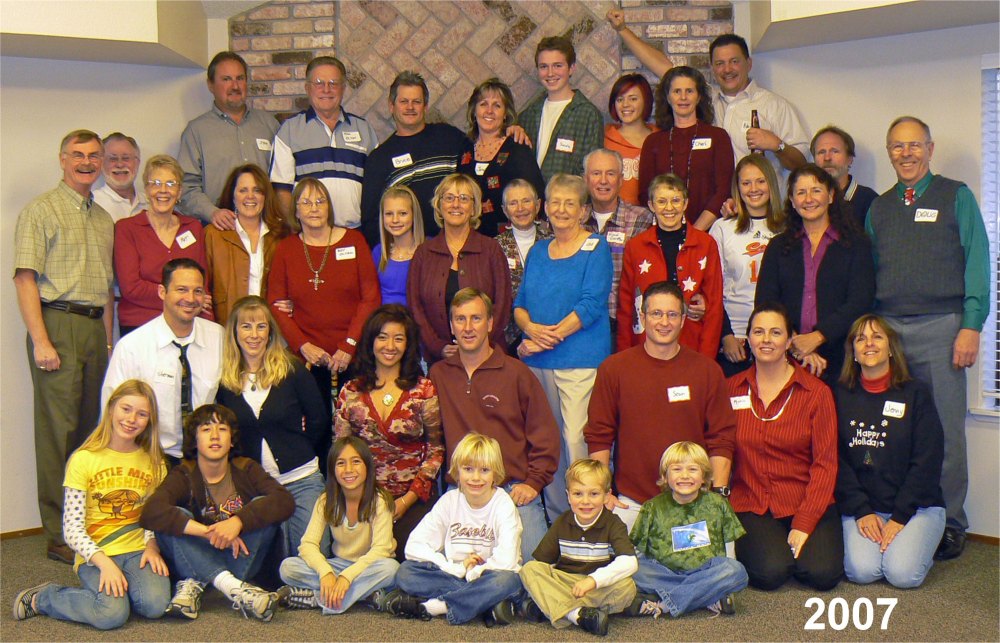 |
December 1, 2007 - The 93rd annual Nankivell/Steynor Christmas Party. There were 39 attendees. |
 |
July 17 - July 20, 2008 - The 16th annual meeting of the QQC was not held in 2008 due to heavy smoke in the air from local forest fires. |  |
December 7, 2008 - The 94th annual Nankivell/Steynor Christmas Party. There were 43 attendees. |
 |
July 16 - July 19, 2009 - The 16th annual meeting of the QQC was held 1 year late. |  |
December 6, 2009 - The 95th annual Nankivell/Steynor Christmas Party. There were 32 attendees. |
 |
July 15 - July 18, 2010 - The 17th annual meeting of the QQC. |  |
December 5, 2010 - The 96th annual Nankivell/Steynor Christmas Party. There were 36 attendees. |
 |
The annual meeting of the QQC has been disontinued. |  |
December 4, 2011 - The 97th annual Nankivell/Steynor Christmas Party. There were 23 attendees. |
 |
The annual Nankivell Xmas Party has been discontinued. |
06 May 2026, 15:33:09